Statement
Before anything becomes an image, a space, or a sound, there is a moment for which no name yet exists.
It is not quite a thought.
It has not yet taken shape.
It has not entered language.
It is only a vague presence, something forming somewhere between sensation, memory, and image. Given enough attention, it may find a way to become visible.
My first encounter with image-making came through painting, not in a formal setting, but beside my father. He was my first and only true teacher; before teaching me technique, he taught me the importance of looking.
From then on, imagination was never confined to an image on paper.
It became a way of pausing.
A way of approaching something I did not yet fully understand.
A way of seeing relationships that do not reveal themselves at first glance.
Painting, before it is about a subject, is about seeing: where the eye comes to rest, what it follows, what it overlooks, and how, through details, it arrives at a whole that is quiet yet alive.
On paper or canvas, every line can reveal one thing and leave another hidden. Every shadow, every interval, every empty surface, and every pause is part of a decision. Sometimes what is removed carries as much meaning as what remains.
Years later, architecture carried this same way of seeing to another scale.
In architecture, the image no longer remains on the surface. It enters life, becoming space, movement, material, and real light, an experience that can be touched and lived, that changes with use and remains in memory.
Perhaps this is where painting and architecture meet: where the image leaves the frame and encounters the human body, time, function, culture, and reality.
Painting can create an inner world, a world faithful to its own laws. Architecture, however, must give that world a tangible presence: one that others can move through, pause within, inhabit, and make part of their own experience.
Along this path, beauty is not enough.
Beauty that remains only on the surface ends too quickly.
What lasts is the quality concealed beneath appearance: a kind of precision, silence, and necessity. It may not explain itself at first glance, but its presence can be felt.
Light, material, color, darkness, sound, distance, and emptiness can each form part of this language. Yet none creates meaning alone. Their value emerges through their relationships with one another. A space or an artwork gains meaning when it allows experience to take shape gradually rather than simply displaying itself.
I have always felt drawn to works that do not explain themselves all at once.
Works that leave something to be discovered.
Something that slows the gaze.
Something that keeps an image, a space, or a sound alive beyond the first moment.
For me, creating is not simply about reaching a result. The result matters, but the path toward it is also part of the truth of the work: a path of seeing, choosing, removing, making, doubting, and looking again.
Sometimes a work reveals its meaning not when it is simply admired, but when it holds the gaze for a moment and allows something to be seen more slowly, felt more deeply, or left as a question in the mind.
Architecture, painting, and music are not three entirely separate paths. Each is a way of approaching a shared quality, one that may never be fully explained, but can be made, seen, heard, or experienced.
Sometimes this quality appears in a dark surface.
Sometimes in a quiet line.
Sometimes in the distance between two materials.
Sometimes in a light that reveals only part of something.
And sometimes in a silence that allows the gaze to linger.
What matters is to create a presence that is not merely seen.
Not merely consumed.
Not made only for the first moment.
A presence that continues in the mind after the image has been seen, after the space has been left, and after the sound has faded.
Perhaps this is what the entire path is about:
to move closer to something between imagination and experience.
Between seeing and understanding.
Between what is made and what quietly remains in memory.


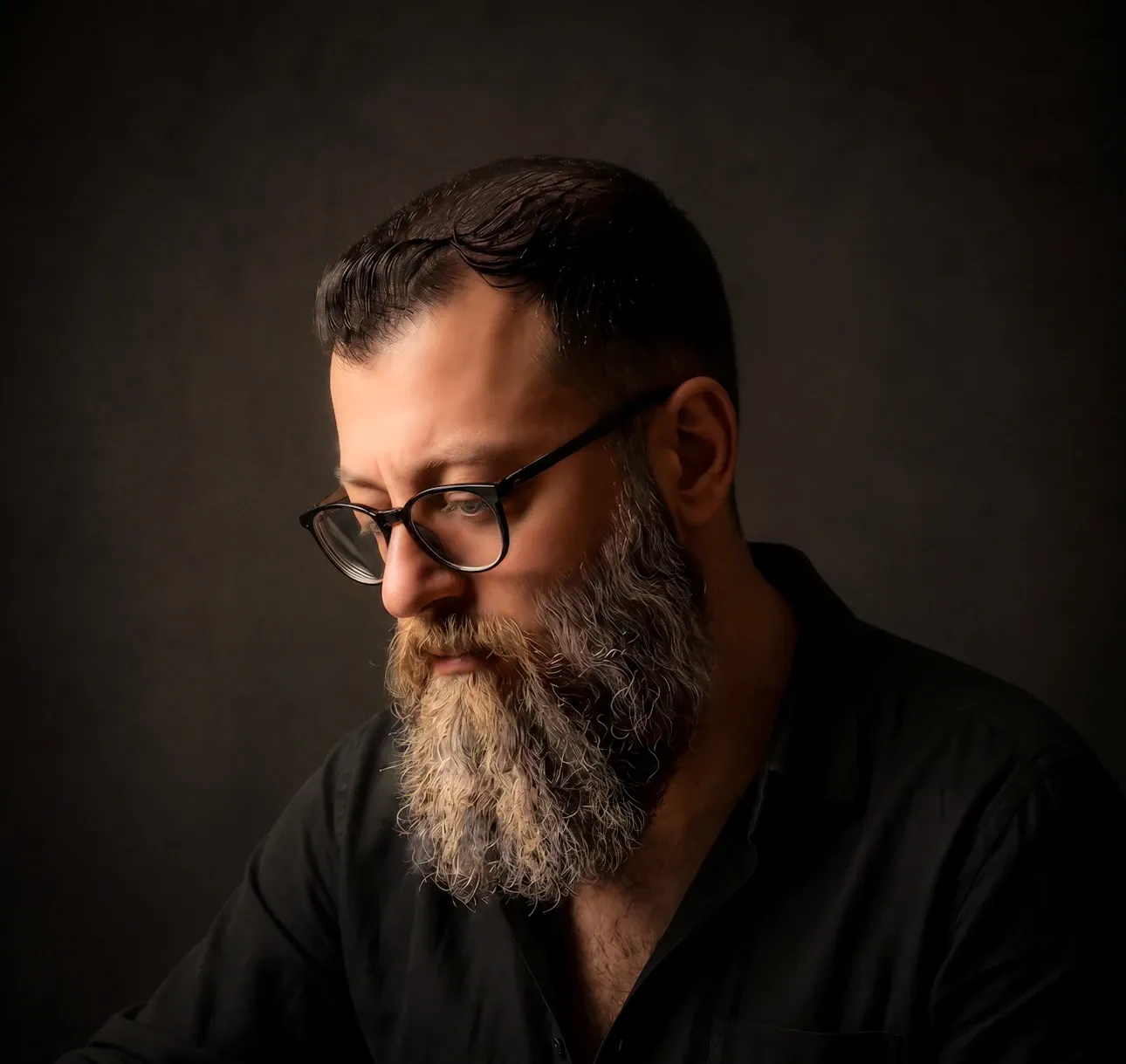
Self-Portrait